


Nigerian politics goes beyond political partisanship and has nothing to do with ideologically motivated viewpoints. Political parties serve as platforms for the pursuit of ethno-political, regional, and even ethno-religious objectives under the pretence of national interest. 2031 won't be any different; Nigeria's stability is precarious because 2023 opened the door for a cankerworm that could blow out if not handled carefully. Similar to vapour in Brownian motion in a pressure cooker, religious and ethnic grievances in Nigeria are real and palpable.
The intricate "triangular" power dynamics of Nigeria—Region, Religion, and Ethnicity—will be discussed in this analysis, along with the possibility that the 2023 "Muslim-Muslim" (M-M) ticket was a singular historical anomaly rather than a new, long-lasting rule. A reassessment of the "North" as a cohesive political voting group is probably going to occur in 2031 when a Southern president is replaced by a Northern one.
Based on existing electoral and demographic patterns. By 2031, the "Monolithic North" illusion that has been dwindling for decades may entirely collapse.
The theory that 2031 will mark the definitive collapse of the "Monolithic North" is supported by shifting electoral data and the deep-seated ethnic-regional tensions.
Nigeria's stability has long relied on the "North" acting as a singular political unit to balance the "South," but the 2023 elections demonstrated that this consensus is fraying.
Here is a detailed breakdown of the factors:
1. The Breakdown of the “Monolithic North”
The concept of a unified “North” has been under pressure for decades, but the 2023 elections showed significant fractures:
The NW/NE Split: The North-West (NW) and North-East (NE) have often vied for supremacy. While the NW (Hausa-Fulani) has traditionally produced more Heads of State, the NE (specifically the Kanuri-dominated Borno/Yobe axis) has developed a distinct political identity. In 2023, the APC’s VP choice (Kashim Shettima, a Kanuri from the NE) was a strategic move to secure that bloc independently of the NW.
The Middle Belt Factor: States like Benue, Plateau, Nasarawa , Adamawa, and parts of Taraba, Gombe, Kebbi, Niger, Borno, Bauchi and Southern Kaduna (often referred to as the Middle Belt) are predominantly Christian or religiously plural. In 2023, these areas showed a high propensity to vote outside the traditional "Northern" consensus, with many leaning toward Peter Obi (LP) or sticking with the APC.
2. Demographic and Electoral Statistics
To understand the “magnitude of the tussle” described, we must look at the numbers.
Estimated Population by Major Ethnic Groups (2024 projections):
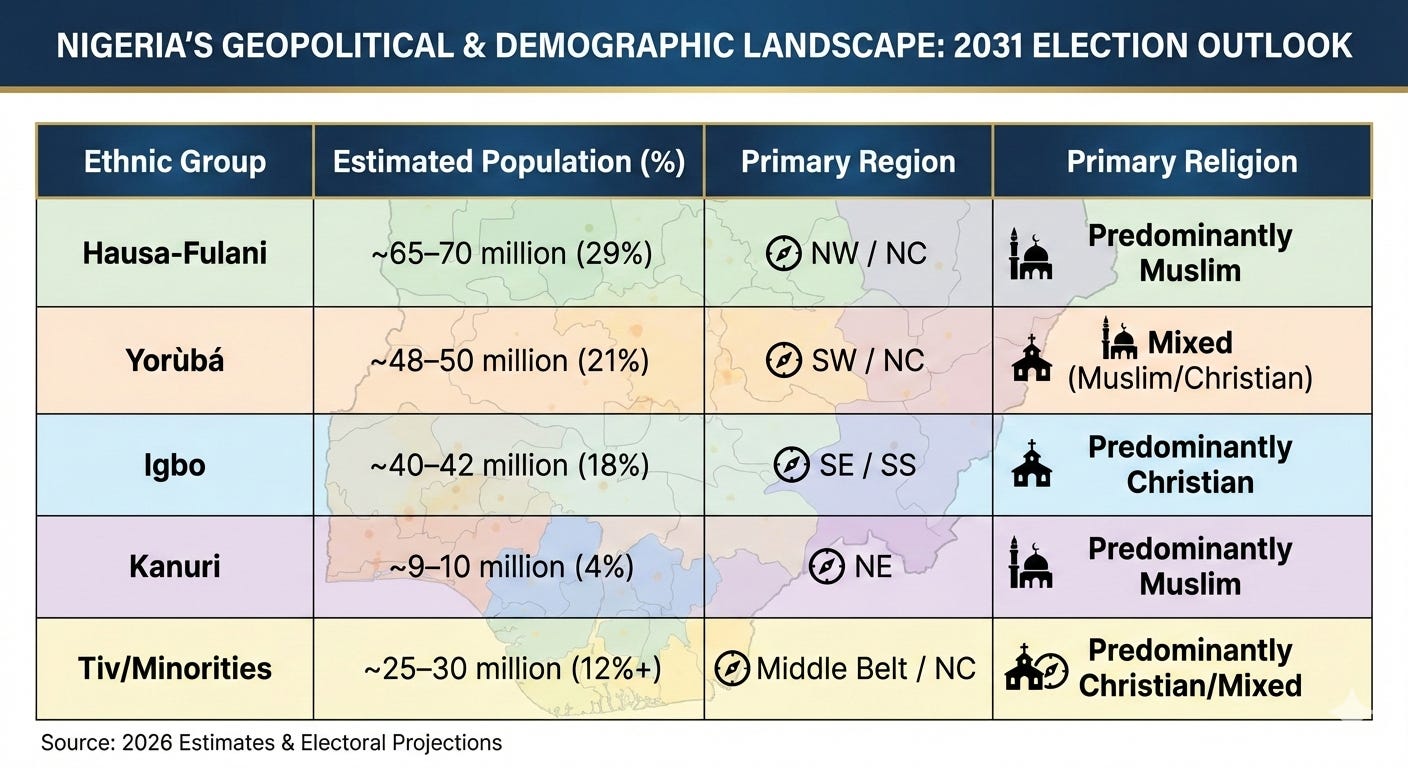
3. The 2031 Religion and Regional Scenarios
North-West (NW): The Hausa-Fulani heartland. With over 22 million registered voters in 2023 (the highest of any zone), it has traditionally dictated Northern terms.
North-East (NE): Dominated by the Kanuri and other minorities. The emergence of the “Borno Power Bloc” (exemplified by VP Kashim Shettima) shows a region no longer willing to be a mere appendage to the North-West.
North-Central (NC/Middle Belt): A religiously pluralistic zone that has increasingly aligned with Southern interests when Northern candidates are perceived as “extremist.”

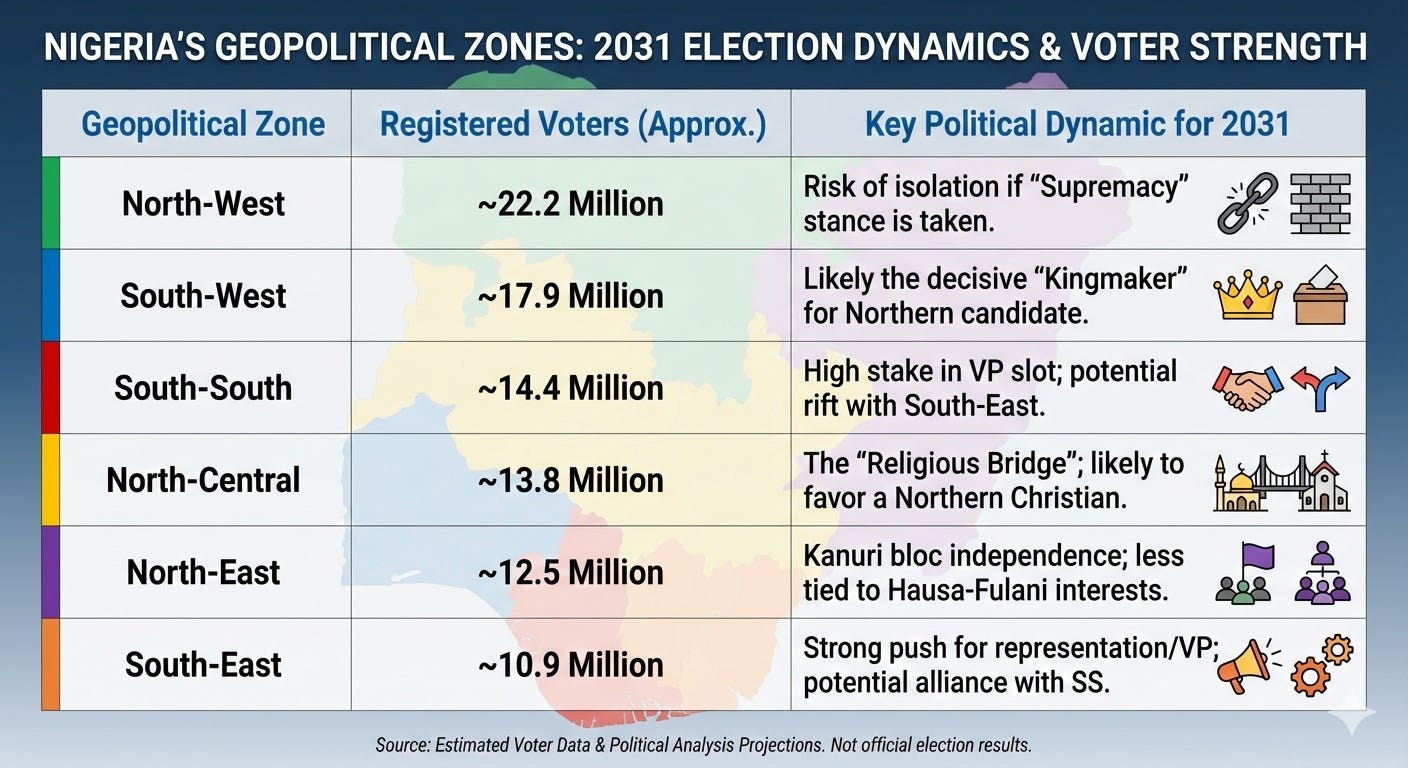
4. The 2031 Tipping Point: The “Northern Christian” Strategy and Risks
If the APC selects a "Muslim from NW" in 2031, it will probably lose the election because even the Kanuri bloc would oppose it on the basis of NW/Hausa-Fulani hegemony rather than Islam, just as the Non-Hausa/Fulani bloc in the entire North would oppose it on the basis of religion, ethnic/regional bloc, or both (in the majority of Christian-dominated parts of the Middlebelt). The South may have almost a single bloc because it has no stake in the Presidency position, the South-West takes a Kingmaker role in national politics and development while being more regionally focused.
Therefore, selecting a Northern Christian as the APC's presidential candidate in 2031 may be path to its Victory and may give rise to a Christian-Christian ticket as the Vice President from the South would probably be a Christian.
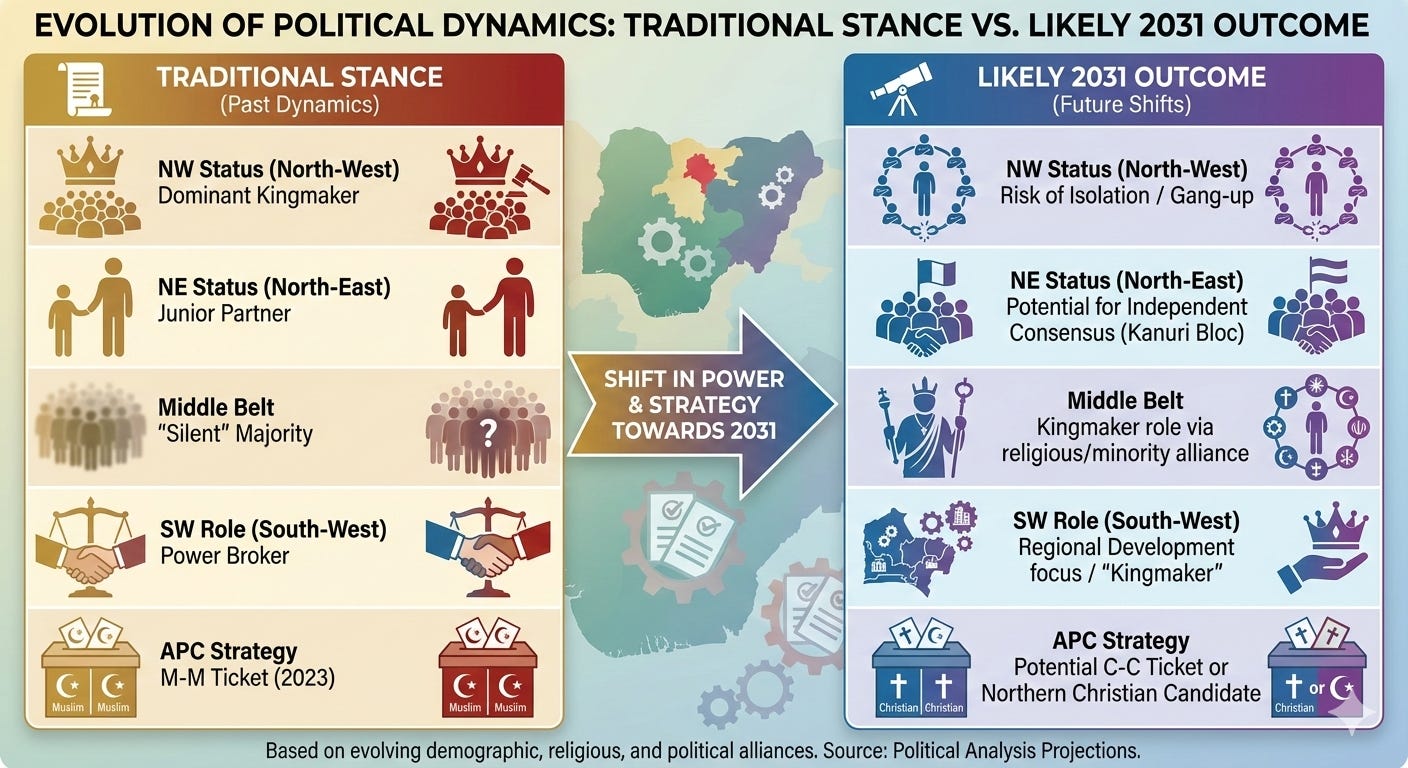
APC might survive by fielding a Northern Christian is a potent strategic scenario. This move would:
Isolate the NW Hardliners: It forces the Hausa-Fulani bloc to either support a “Northern Brother” who is Christian or risk losing power entirely to a Southern-Middle Belt Coalition.
The Christian-Christian (C-C) Ticket: If the successor is a Northern Christian, the VP would logically be a Southern Christian (from the SE or SS) to maintain the regional “North-South” balance. This would be a mirror image of the 2023 M-M ticket and could theoretically consolidate the “Christian vote”.
5. Risks for the North-West
The North-West risks “Political Isolation” if it maintains an uncompromising stance on producing a Muslim successor.
The "Gang-up" Math: If the North-West (29%) insists on producing a Presidential Candidate, the remaining 71% of the population (represented by the South, Middle Belt, and North-East) has a clear mathematical path to victory through a "Coalition"
The Kanuri Factor: If the NE (Kanuri) decides that their interests are better served by a non-Hausa-Fulani alliance, the NW loses its “Islamic Solidarity” shield.
The “Yorùbá Muslim” Precedent: President Tinubu’s success proved that a Southern Muslim Candidate can win if they are perceived as “inclusive” or “non-extremist.” A conservative NW Muslim candidate in 2031 will not enjoy this “Southern Grace” and will likely face intense scrutiny from the South and Middle Belt regarding “Islamist tendencies”.
Conclusion: The “Co-Kingmaker” Path
The most stable outcome involves the North-West adopting the “Yorùbá Model”—sitting back, providing the votes, and acting as a co-kingmaker with the South-West. If they instead push for absolute supremacy, the “Monolithic North” will not just shatter; it will likely be outmaneuvered by a coalition of the Middle Belt, North-East, and Entire South.
International Interests and Deplatforming
The International community, which views Nigeria as too big to fail, would likely support any coalition that prevents the country from sliding into the religious extremism or regional secession that a polarized 2031 election might trigger.
International interests prefer stability.
A candidate perceived as a "religious hardliner" would likely face significant diplomatic friction, as the global community prefers the "Yorùbá Model" of religious pluralism for a country as volatile as Nigeria
This could manifest in the form of election monitoring, support for civil society, or pressure regarding security cooperation and sanctions.
Nigeria has already been named a Country of Particular Concern, and the Trump administration has adopted a pro-Evangelical posture. Israel has expressed interest in "safeguarding Christians" from "Radical Islamists" in Nigeria.
Absolutely good analysis of the Nigerian miasma