


The Colonial Band-Aid: How British Amalgamation Masked Nigeria’s Unresolved Hostilities
Before British colonisation, there was no peace in precolonial Nigeria. The British encountered warring kingdoms and empires, but they pursued the policy of maintaining or bringing about peace to the Polity in order to govern what would eventually become Nigeria following the Berlin Conference in 1884–1855. While the British were in Nigeria, they were able to maintain peace, but it would soon come to an end. Seven years after Nigeria gained her independence, the people resumed their hostilities. British colonisation only put a halt to the unresolved conflicts in precolonial Nigeria.
Nigeria has experienced sporadic crises since gaining its independence, including riots, political unrest, civil war, and military coups. However, in the 1970s, an ideologically motivated group known as Maitasine emerged in Nigeria for the first time since the popular Fulani Jihad of Gobir (Sokoto) in 1804. This group was led by a radical preacher from Cameroon named Alhaji Muhammad Marwa, who commanded followers in Kano and other Northern Nigeria.
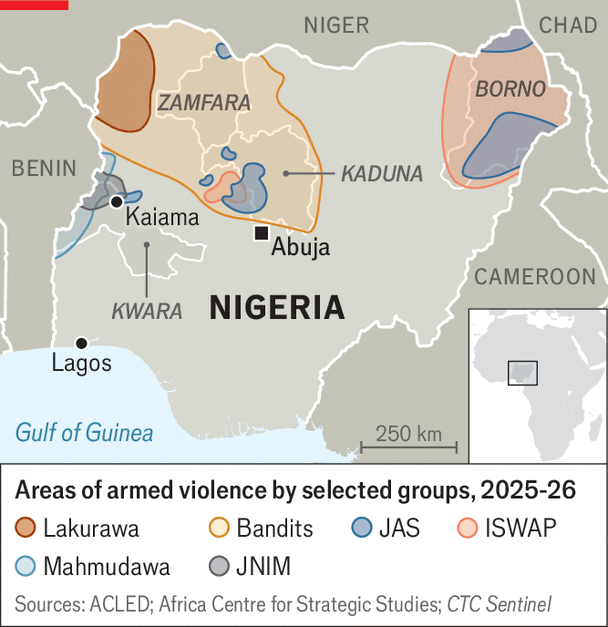
Then, in early 2000, following Nigeria’s return to civilian and democratic leadership, Yusufiyah began, giving rise to JAS, also known as Boko Haram. In 2012, JAS underwent its first split, giving rise to rival Alqaeda-affiliated ANSARU Islam. In 2016, IS-affiliated ISWAP emerged, and Nigeria now has JAS (BH), ANSARU Islam, ISWAP, Darul Islam, and, more recently, Lakurawa (likely ISSP/ISGS), Mahmuda, and JNIM.
JAS and ISWAP have operated in the North-East and Lake Chad for decades, while ISWAP has been more involved in a few incidents outside of the North-East, such as the Abuja-Kaduna Train attack and the Kuje Prison attack. Meanwhile, ANSARU has terror cells in Okene/Ebiraland and other parts of Kogi State, and it has been involved in numerous bank robberies, high-level kidnappings, and attacks on police stations that have spread to Ondo, Edo, and Ọṣun States and Abuja.
The Siege on the Heartland: The Encroachment of Jihadi Terror into the South-West
By June 2022, the Yorùbá heartland’s operating theatre had begun when a Jihadi terror strike occurred for the first time in the South-West at St. Francis Catholic Church in Owo, Ondo State.
Despite the Fulani Militia’s attacks on sedentary farming communities in the predominantly Christian Middlebelt of Nigeria, which can be characterised as an ethno-religious genocide campaign, Kwara and Kogi-West/Kogi State were spared for decades. Though Yorùbáland had been caught up in the increased Fulani Herders’ hostilities against farmers and communities in Yorùbáland, these began to change by 2023. This led to the emergence of Sunday Igboho as a non-state actor and pro-Yoruba separatist sentiment, which ultimately led to the creation of the Western Nigeria Security Network, codenamed Amotekun, by states in the South-West Geopolitical Region. At this point, there had never been any known religiously motivated jihadi attacks in the South-West or Yorùbáland in general.
In February 2026, the Woro community in Kaiama Local Government Area of Kwara State was invaded by a Jihadi Militant Group suspected of being members of Jama’atu Ahlis Sunna Lidda’awati wal-Jihad (JAS), also known as Boko Haram, led by a faction leader named Sadiku. The Jihadists killed 178 people, mostly men, and took 200 people, mostly women and children, hostage before marching them into an unidentified location. JAS has since released a video of the abducted individuals. This marks a significant milestone in JAS's operations in Yorùbá World and its nearby neighbours, Nupe and Borgu, to the north.
The RUGA Legacy: Land Usurpation, Settler Colonies, and the New Frontier of Terror
Organised Fulani Militia gangs, commonly known as bandits, began launching serious attacks on Kogi-West, also known as Okunland, the Yorùbá-speaking region of Kogi State, in 2023. These gangs would soon spread into Kwara State, particularly Kwara South and Kwara North, which border Kogi West to the east and Niger State to the north. I looked into what could have caused this and why now. The responses I received were incredibly implausible and might be regarded as conspiratorial.
The Late President Muhammadu Buhari-led administration attempted to pass the RUGA and Water Resources Bills in order to create Federal Government-owned colonies for Pastoralists or nomadic herdsmen. However, the bills were thwarted because they were highly contentious, raised suspicions, and were seen as a sinister plot to usurp Indigenous or native lands from peoples in order to create Settler Colonies for future resource conflicts.
The Ebira-Fulani Alliance: Political Proteges and the Destabilization of Okunland
Alhaji Yahaya Bello, the former governor of Kogi State, was reportedly consumed by his desire to see his protege and Ebira Kinsman succeed him.
He reportedly welcomed this idea from the Federal Government and reported that Fulani herders were welcomed in large numbers in the state, with truckloads of cattle and herders pouring in every day.
More significantly, he allegedly did not give Ebiraland to the migrant herders, but rather Okunland/Kogi-West for this experiment.
There were serious repercussions:
The population of many villages and towns where Fulani herder migrants settled drastically changed, and they established settlements they called “Zango.”
In order to communicate with these communities, the locals had to learn Hausa and Fulfude languages.
With a dark “Ebira-Fulani Alliance,” he was able to effectively make his kinsman and protege to succeed him as governor of the state during an Ebira-Ebira transition.
This analysis has political implications.
The Greater Fulani Ambition: Mapping the Geopolitics of Expansion in the Niger-Benue Trough
From Futa Jalon and Futa Toro along the Sene-gambia River to Macina and Tukulor Emirate in Mali along the River Niger, and Madibbo Adama’s raids and push for access to the Benue Valley along present-day Adamawa, an unmistakable pattern can be seen throughout history. Perhaps because Okunland from Lokoja is immediately west of the River Niger, it’s a continuum of “Greater Fulani,” but this doesn’t mean that all Fulani in the world “agree” or even had consensus about this goal or ambition.

The “Bandit” Euphemism: Unmasking the Fulani Militia’s War on Sedentary Communities
According to the BBC documentary “Bandit Warlords of Zamfara,” “Bandits” are semi-independent or independent Non State Militia gangs that seek financial and territorial rewards for their acts of terror.
The Cognomen term “Bandit” is simply a euphemistic term for “Fulani Militia Gangs.”
They are merely material-driven militias, but they use ethnic sentiment or chauvinistism to defend their actions by pointing to the marginalization and criminalisation of Fulani people, the lack of commitment on the part of the Federal Government of Nigeria to improve their society and people, and actions against communities hostile to the Fulani and their nomadic culture.
They aim to replicate their demands and rationale for their acts with the Amnesty Program and the Niger Delta Militant. These bandits’ operational threat has been in the north-west, where Hausa and Fulani communities are localised or entangled. The Chief of Army Staff, the Late General Taoreed Lagbaja, conducted significant offensive theatre operations against bandits in the North-West when President Bola Ahmed Tinubu assumed the presidency of the Federal Republic of Nigeria in 2023.
The current president is from the Yorùbá Speaking Nation of Nigeria, so it’s possible that they expanded their operations to Kwara-Kogi to send a message to the Federal Government of Nigeria, which they resent. However, they chose not to do so when the late President Muhammad Buhari was in office.
Things Yorùbáland Needs to Do:
The Western Nigeria Security Network, codenamed Amotekun has to sign an operational memorandum of understanding with the states of Kwara, Kogi, and Niger for cross-border operations.
Demand for divisions or permanent military bases along the Kwara-Kogi axis.
Demand that the establishment of State Police be accelerated.
Every South-West State, including Kwara and Kogi, is required to acquire Reconnicance drones as well as other security and military equipment.
In order to respond to emergency situations more quickly, all South-West states, Kwara, and Kogi states should grade or build roads in remote and rural areas through RAAMP.
The Security Trust Fund, which South-West announced under the DAWN Commission, needs to be realised.
Amotekun should receive more training and recruiting, as well as better enumerations and a better reward system.
Ungoverned areas, such as border towns, which have frequently been disregarded by governments, ought to have more security and be easier to reach.
SOS technology for prompt action in emergency situations.
To reduce fatalities from ambushes, State Governments must invest in heavily armoured vehicles and Armoured Personnel Carriers from Pro force.
Activities related to illegal mining should be stopped.
The South-West Geopolitical Zone and the Benin Republic need to establish a security network or collaboration.
To build cooperation with the police and military, the South-West States, Kwara, and Kogi States must support and encourage local vigilante groups and militia groups like OPC and Agbekoya.
The Creation and registration of private security firms similar as PMC Wagner or Black Water should be funded or pursued by a few prominent and affluent Yorùbá patrons.