

The Sahelian Nexus: An Analysis of Militant Expansion in Nigeria
As Jihadists Move South, Nigeria's Yoruba Land Becomes the New Frontline


Introduction
The security architecture of Nigeria and the wider West African region is under severe strain from a complex mosaic of non-state armed groups. While often perceived by the public as a monolithic threat, these actors are driven by distinct ideologies, goals, and operational methodologies. This analysis distinguishes between the primary militant factions, establishes Northern Nigeria’s core Sahelian identity as a critical factor in the conflict, and examines the southward expansion of jihadist groups towards Nigeria’s Yorùbá heartland and the coastal states. This trajectory carries profound implications for regional stability and international engagement.
A Typology of Non-State Actors in Nigeria
The landscape of instability in Nigeria can be broadly categorised into two groups: religiously motivated Islamist militants and actors driven by other factors.
1. Islamist Militant Groups
These organisations are unified by a fundamentalist interpretation of Islam and the ultimate goal of establishing an Islamic state governed by their strict interpretation of Shari’a law. Key groups include:
Boko Haram (Jama’atu Ahlis Sunna Lidda’awati wal-Jihad, JAS): The original and most notorious jihadist franchise in Nigeria, known for its extreme violence against civilians and state targets. Its core leadership and support base are predominantly Kanuri.
Islamic State West Africa Province (ISWAP): A Boko Haram splinter faction that pledged allegiance to the Islamic State (IS). While equally brutal, ISWAP has demonstrated more strategic acumen in governance and resource control. It retains a Kanuri core but has pragmatically integrated Hausa and Fulani fighters to broaden its reach.
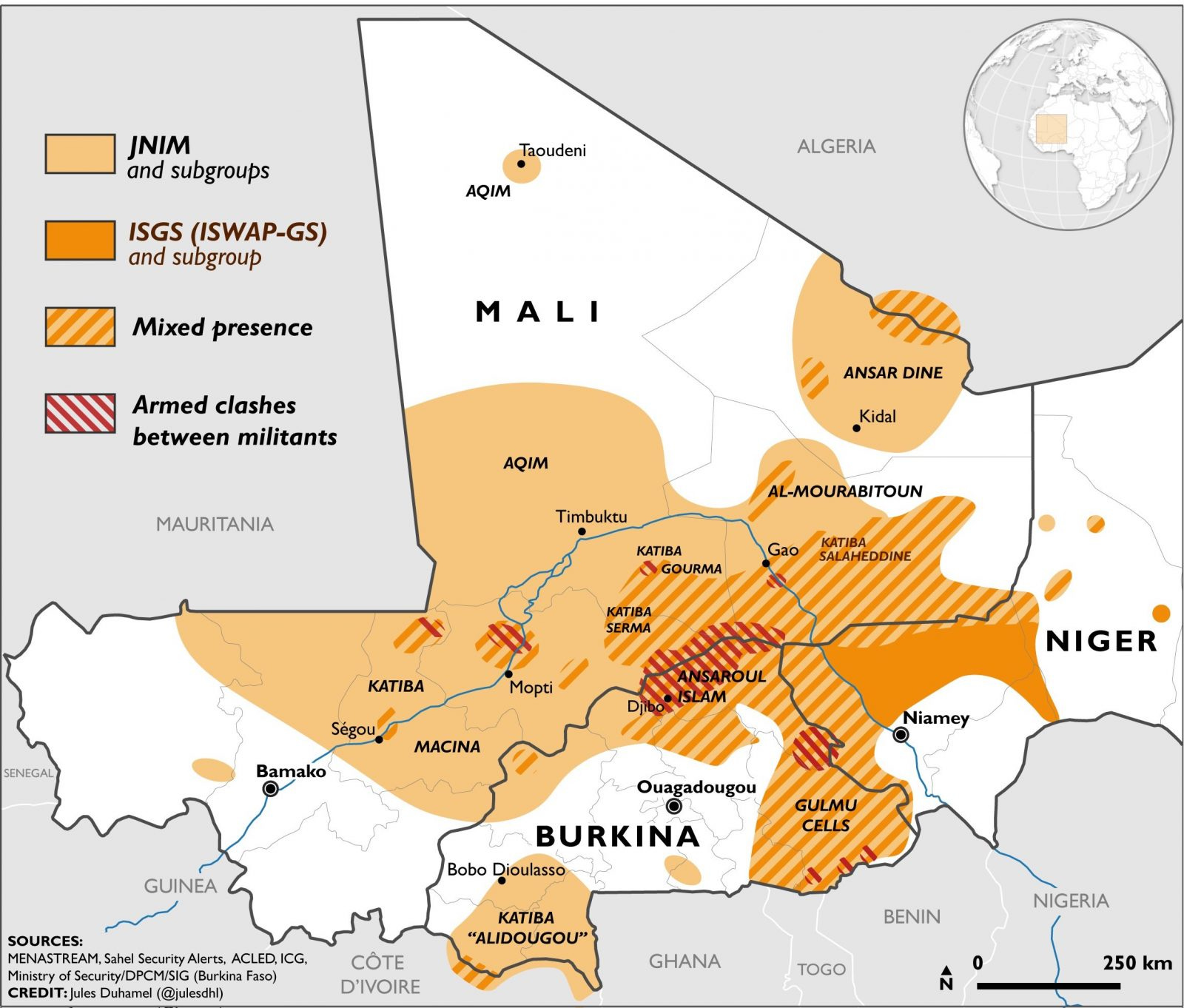
Jama’at Nusrat al-Islam wal-Muslimin (JNIM): An Al-Qaeda affiliate and the most potent transnational jihadist force in the Sahel. Its leadership and core are predominantly Fulani (Peul) and Tamasheq (Tuareg). Its presence has been reported in Nigeria, with cells identified as far south as Kwara State, the northernmost region of Yorubaland.
Ansarul Islam: A Fulani-composed group aligned with JNIM, representing the jihadist radicalization of a segment of the Fulani youth. It serves as a key vector for JNIM’s influence in border regions.
Emerging & Associated Factions: The militant scene is further fragmented by hyper-localized factions that operate as satellites to the major groups. These include Lakurawa and Wolowolo (Fulani-dominated militias aligned with JNIM and active in Sokoto and Zamfara), the Islamic State in the Sahel (ISS) (a rival to JNIM), and other cells like Mahmud, which typically consist of Fulani and Hausa fighters and blur the lines between banditry and jihadism.
2. Non-Religiously Motivated Militant Groups
These actors, while exacerbating insecurity, are primarily driven by secular motives such as economic gain, ethnic nationalism, or resource control.
Bandit Groups: Predominantly in the North-West, these criminal syndicates engage in mass kidnapping, cattle rustling, and pillage. While occasionally adopting religious rhetoric, their core driver is profit.
Pro-Secessionist Groups (e.g., IPOB): Active in the South-East, these groups seek political separation from the Nigerian state, with their militancy rooted in ethnic grievances and political marginalisation.
Fulani Militia: Operating across the Middle Belt and Southern Nigeria, these militias are involved in targeted killings of indigenous populations. While often framed in ethno-religious terms, their actions are strategically conducted for the purpose of land grabbing and demographic replacement in these contested areas.
Niger Delta Militants: Historically focused on resource control and protesting environmental degradation and economic neglect in the oil-rich Niger Delta.
Despite their different drivers, all these groups challenge the state’s monopoly on violence, resulting in significant loss of life, widespread displacement, and a deepening humanitarian crisis.
Ideological Schisms and Strategic Objectives of Sahelian Jihadists
A critical distinction lies in the ideological stance of the jihadist groups. Although they share a common goal of a Caliphate, significant doctrinal differences dictate their tactics and internal conflicts. They collectively view the secular Nigerian government as illegitimate and regard non-Muslims as Kuffar (unbelievers), subject to Takfir (excommunication), which they use to justify violence, enslavement, or forced conversion.
The schism between JAS (Boko Haram) and ISWAP is particularly illustrative:
• JAS Doctrine: Adopts a takfirist stance against Muslims who do not subscribe to its specific doctrine. It considers Muslims living under the Nigerian state or even under ISWAP rule as apostates (Murtadun), making them legitimate targets.
• ISWAP Doctrine: Takes a more pragmatic, if still extreme, approach. It generally considers Muslims to remain Muslims unless they are directly serving the state as soldiers, informants, or government officials. ISWAP regards JAS as Khawarij (a historical reference to Muslim extremists who rebel against the established order), signalling a deep theological and strategic rift.
This ideological dispute is compounded by a struggle over the “shadow economy.” Control of territories, smuggling routes, and illicit markets generates significant revenue. ISWAP, in particular, has grown financially robust, reportedly funding other IS affiliates globally. The conflict over territory is thus both an ideological and an economic imperative, fuelling their jihadist campaigns.
Similar conflicts are visible elsewhere in the Sahel. In Mali and Burkina Faso, JNIM and the Islamic State in the Greater Sahara (ISGS) clash over territorial control and ideological nuances, such as the appropriate timing for implementing Shari’a law and sectarian interpretations of theology.
Northern Nigeria: The Sahelian Frontline
Geographically and culturally, the core Northern states of Nigeria—Borno, Yobe, Jigawa, Kano, Katsina, and Sokoto—are an integral part of the Sahel region. This is not merely a geographical classification but a strategic reality. These states sit squarely within the Sahelian climatic zone and are historically and culturally linked to the wider Sahelian world through the legacies of the Kanem-Bornu and Sokoto Caliphates. The porous borders, shared ethnic and linguistic ties with neighboring Niger and Chad, and similar socio-economic conditions make this area a natural extension of the central Sahelian conflict zone. The instability in Mali, Niger, and Burkina Faso directly fuels the crisis in these core Northern Nigerian states, with militants, ideologies, and weapons flowing freely across ungoverned spaces. Recognising this belt of states as a Sahelian frontline is essential for understanding the transnational nature of the jihadist threat.
The Middle Belt: A Contested Frontier and Zone of Suffering
Situated geographically and politically between the core Muslim-majority North and the Christian-majority South, the Middle Belt is not merely a transition zone but a deeply contested frontier. It constitutes the northernmost extent of what can be considered the “Southern” or “non-Sahelian” political and cultural sphere of Nigeria. Historically, this region has borne the brunt of overlapping conflicts, serving as a bloody arena where the tensions between the Sokoto Caliphate’s expansionist history and the indigenous communities crystallized.
The suffering of the Middle Belt’s ethnically diverse, predominantly Christian and animist communities is rooted in a long history of subjugation. In the pre-colonial era, the region was a primary target for slave raids by the Sokoto Caliphate. The colonial administration’s policy of Indirect Rule further entrenched this dynamic by empowering Northern Muslim emirs over Middle Belt communities, forcibly incorporating them into a political structure they had historically resisted. In the post-colonial period, this pattern has persisted through systemic political marginalization, economic neglect, and the imposition of a “Northern” identity that erases their distinct cultural and religious heritage.
This historical context is the backdrop for the current campaign of violence. The conflicts are often wrongfully/simplistically framed as “farmer-herder clashes,” but evidence points to a more strategic objective. Attacks by militant Fulani herders on indigenous communities are characterized by targeted killings, designed to terrorize populations, force displacement, and seize control of territory. The primary driver is not mere resource competition but a concerted effort at land grabbing and demographic replacement, aimed at permanently altering the ethnic and religious landscape of this strategic frontier.
Consequently, there is a growing and potent political movement within the Middle Belt seeking a definitive schism from the “North.” Prominent socio-political organizations and leaders are actively advocating for the creation of new states or regions—such as the “Middle Belt Region”—to escape the political domination of the far North. This is not merely an administrative demand but a profound quest for political self-determination and security. The goal is to forge an independent reality within Nigeria where their unique identities are protected, their security is prioritized, and their historical grievances are acknowledged. The expansion of jihadist violence into this already volatile region therefore risks not just escalating a local conflict, but accelerating a fundamental re-ordering of Nigeria’s internal geopolitical boundaries.
The Geopolitical Context: International Withdrawals and Regional Repercussions
The strategic calculus of Sahelian jihadist groups has been profoundly influenced by recent international events.
• The Afghanistan Precedent: The U.S. withdrawal from Afghanistan and the Taliban’s subsequent takeover served as an energetic inspiration for jihadist groups worldwide. In the Sahel, groups like JNIM and IS-Sahel interpreted this as evidence that sustained insurgency can compel Western powers to disengage. The subsequent expulsion of French forces and the drawdown of other international counter-terrorism missions from the Sahel have reinforced this narrative of victory.
• Shifting U.S. Foreign Policy: The U.S. appears to be recalibrating its engagement in West Africa. Lacking the strategic economic interests (like oil) that define its presence in the Middle East, U.S. policy may be shifting towards a strategy of containment. This involves establishing a strategic buffer in the coastal West African states—Nigeria, Benin, Togo, Ghana, and Côte d’Ivoire. The potential establishment of a larger U.S. consulate or military footprint in Lagos signals a intent to fortify these coastal nations against the spillover of Sahelian instability.

This prospective U.S. military presence in coastal West Africa carries significant consequences. In the context of Northern Nigeria, which is deeply embedded in the Sahelian crisis, such a presence is likely to be perceived not as a stabilising force, but as an imperialist incursion and an anti-Islamic “Crusade.” This perception could serve as a powerful recruitment tool for groups like ISWAP and JNIM, potentially leading to a dramatic surge in militancy and insecurity as a form of deviance and resistance.
This dynamic of Northern solidarity with the Sahel was starkly illustrated following the 2023 coup in Niger Republic. When the Nigerian President, Bola Tinubu, considered leading a ECOWAS-sanctioned military intervention to restore democratic order, he faced immediate and severe backlash from powerful Northern political and traditional elites. Figures like the former Vice President and the Sultan of Sokoto, alongside Northern senators, openly opposed the move, framing an intervention as an attack on their “kinsmen” in Niger. This opposition escalated to the point where explicit threats were made, warning that any military action against Niger would be considered a “declaration of war” on Northern Nigeria itself, a statement that bordered on sedition and highlighted the profound schism between national policy and regional allegiance. This incident starkly demonstrated that the Nigerian state’s capacity to project power and influence in the Sahel is critically hamstrung by its own domestic fragility. The federal government cannot pursue a robust regional security policy if such actions are perceived as a betrayal by its own northern population, effectively ceding veto power over national foreign policy to a region whose sympathies are deeply enmeshed with the Sahelian crisis.
The Southern Expansion: The Threat to Yorubaland and the Coast
The most alarming trend is the southward drift of jihadist activity. The confirmed presence of JNIM cells in Kwara State demonstrates that the ideological and operational reach of Sahelian jihadists now extends into the northern fringe of Yorubaland. This region has historically been more stable than the far north.
This expansion is driven by several factors: the pressure from military operations in the core north, the search for new resources and recruitment grounds, and the strategic objective of linking with sympathisers in other regions. If this trajectory continues, the next frontier of conflict will be the Middle Belt and South-West Nigeria, threatening the country’s most populous and economically vital areas. The consequence would be a national crisis of unprecedented scale, directly targeting Christian communities and Muslims who oppose their extremist ideology, and potentially causing a 2000% increase in insecurity, as the original text suggested, through widespread deviance and resistance.
Conclusion
The militant threat in Nigeria is not a single problem but a syndicate of distinct yet sometimes overlapping crises. The ideological-driven jihadists of the Sahel, with Northern Nigeria as their southern beachhead, represent the most existentially dangerous vector due to their transnational nature and totalitarian goals. Their expansion is synergistically enabled by the parallel campaign of land grabbing and violence by Fulani militias in the Middle Belt, creating a pincer movement that threatens the nation’s core. The withdrawal of international forces from the central Sahel and a potential U.S. pivot to a coastal containment strategy risk further inflaming tensions in Northern Nigeria while doing little to halt the groups’ territorial advance. The reported infiltration into Kwara State is a clear warning that the conflict is escaping its traditional boundaries. Without a coherent, regionally-led strategy that addresses the root causes of instability and effectively counters both the ideology and the shadow economy of these groups, the threat will continue its march towards the vulnerable and politically pivotal regions of Southern Nigeria and the coastal West African states, with devastating humanitarian and geopolitical consequences.
As always I implore you to observe the words below:
It’s okay to be different.
It’s okay to be you.
It’s okay to feel like, indifferent and hate towards others.
It’s okay to be as human as every other group across the world.
It’s perfectly reasonable to want to be independent of others on lands that are yours.
As an African, it’s okay to be just another human being.
Be sure to share, like, comment and subscribe across all platforms.
