


If First Generation African leaders had desired True freedom of Africa, they should not have supported the strict policy of upholding the integrity of colonial borders once the colonies were awarded freedom. African leaders, both then and now, have maintained the hypocrisy of wanting an end to colonisation by adamantly upholding the colonial borders that were established without the consent and context of Africans themselves. Meanwhile, with intentional ignorance, some Pan Africanists continue to propagate the idea of neocolonialism in Africa, accusing Europeans of exploiting Africa, keeping it impoverished, and engaging in what they called White Supremacy.
The Flaw of 1963: How the OAU Failed the African Agency
A period of self-determination for all African populations and the ratification of existing empires, kingdoms, or states at the end of the 19th century by referenda would have constituted true decolonisation of Africa. An illustration of the Swiss Confederacy, Malaysia-Singapore, or India-Pakistan-Bangladesh. This would have rectified the mistakes made during the 1884–1885 Berlin Conference, which initiated the legalisation and formalization of African colonisation. The OAU (now AU) adopted the “Policy of maintaining the Colonial borders to prevent conflicts in Africa,” which has shown to be flawed since easy paths aren’t always the best ones.
The contemporary reality that African states do not war seem quite the boon until you realise all violence, destabilisation, conflicts, wars, genocides, etc are trapped within the individual states between ancient ethnic groups, kingdoms, nations and empires competing for supremacy, resources and influence.
Inherent Instability: The Link Between Artificial Borders and Intra-State Conflict
It is crucial to remember that the majority of conflicts in Africa are “Intra-State Conflicts and Wars” (conflict within the state/countries) rather than “Inter-State Conflicts” (conflict between 2 states/countries) or “Wars”. African nations are the least stable in the world, with the majority of them being devastated by sporadic deadly conflicts within their borders. The majority of African militaries focus most of their efforts/capabilities on preventing intra-state conflicts than inter-state conflicts. Due to the lack of national identities in the majority of African countries, particularly those in sub-Saharan Africa, these nations have frozen ethno-national identities. As a result, the constituent groups that make up each African state continue to exist in ethno-identical Civilizational states similar to those found throughout the world.
According to data from the UCDP/PRIO Armed Conflict Dataset, between 1946 and 2021, Africa has experienced over 300 distinct internal armed conflicts, while the number of "traditional" interstate wars (country vs. country) remains in the single digits.
The majority of African states, particularly those in sub-Saharan Africa, lack the homogeneity that should serve as the foundation for national identity. Africa is the world’s most diverse continent, so it is impractical for every ethnic group to have its own ethno-state. Nevertheless, Africans have never been granted the right to self-determination to choose their statehood, and their opinions have never been acknowledged. In the hearts of Africans themselves, the majority of sub-Saharan African nations are imaginary and fake states. Contrary to the widely held belief that Europeans divided Africa and took control, many African communities were pleased to sign treaties with colonial states to defend themselves against local bullies, who are typically rival city states or other African groups or kingdoms.

The idea of “Protectorate” in Africa was about “Formal Protection allyship” from other Africans and rival Colonial Powers seeking administrative influence in the region.
Europeans then sought to end all wars and conflicts in Africa in order to administer and rule the Africans using arbitrary borders of convenience.
Africa is the world’s most linguistically and genetically diverse continent, in addition to being the most culturally diverse.
Decolonizing the Map: Why Skin-folk is Not Kinfolk
The notion that all Africans are the same negroid with melanin is absurd; it would be equivalent to claiming that all Asians are the same, which would mean that Han Chinese, Japanese, Javanese, Koreans, or all Europeans are the same.
Africans are not “Black” in Africa: Despite their skin colour, some African groups are more genetically similar to some European groups than to other African groups; people in Africa have their realities in their ethnic groups rather than racial realities; even the idea of being African is rarely felt; they are only classified as “Black” when they are among other races like White or Asian.
Within Nigerian borders, the cultural distinctions between Yorùbá and Kanuri are similar to those between Yorùbá and Germans.
From Colonial Constructs to Civilizational States: A Path to African Stability
Not only was Africa colonized and even occupied in the 19th century, but the Korean Peninsula was also occupied and colonized by its neighbours at various points in history, as was the Qin Dynasty of China, British India, and other places. Colonisation is not a recent phenomenon.
If I were to expand on this, I would even suggest that Russians colonized Mongolia, Eastern Europe, and the Balkans. It’s possible that Balkan nations were the last in the world to gain Independence after the collapse of the Soviet Union under Mikhail Gorbachev.
Today, With a projected nominal GDP, Poland’s economy is now expanding significantly and quickly.
Africa’s Lost Time: How Asian-Style Self-Determination Could Have Saved a Continent
The British Empire and its colonies in Africa would be viewed as “colonisation” on the basis of White vs. African/Black racial realities because most people would not consider what the Russians did during the Soviet Union, the Japanese during the Imperial Japanese Empire, or the Roman/Greek Empire as colonisation based on race and skin colour, forgetting that peoples of the same race could colonise one another and had nothing to do with racial differences. However, Asia and Europe only lost time, not self-determination, in contrast to Africa, which lost two crucial components of development due to colonisation: time and self-determination.
Post Colonial Africa VS Post Colonial Asia
When Imperial Japan gave up its colonies in Korea, China, and the Philippines, they simply returned to their pre-colonization state and lost only TIME. British India, on the other hand, sought self-determination as soon as it gained independence by dividing into Hindu-majority India, Muslim-majority Pakistan and Bangladesh, Singapore and Malaysia, and China returned to the state of its Qin Dynasty.
African nations such as Kanem-Borno, Sokoto Caliphate, Yorùbá Country (Ibadan, Èkìtì federation of Kingdoms, Ijebu Kingdom, New Òyó Kingdom, Ijesa, and many more), Benin Kingdom, Dahomey, Ashante Empire, Fante Confederacy, Kingdom of Kongo, Emirate of Nupe, Zulu Empire, Macina Emirate, and many more simply abandoned their agencies and refused to return to their pre-colonization state.
Rather, under the Organization of African Union, or OAU (later AU), they decided to keep the artificial borders and countries that Europeans had formed without the consents or context of Africa.
Africans would have pursued the creation of new states with their consent and contexts (self-determination) if they had followed different paths like Asians and Eastern Europe. The Emerging States might have been:
Through a treaty or charter, a number of Yorùbá Kingdoms and City States may have consented to join a single nation state. They may also be willing to unite with the Benin Kingdom and the Dahomey Kingdom to create a nation that resembles Switzerland, Belgium, or the United Kingdom.
Perhaps comparable to the United Arab Emirates, the Sokoto Caliphate (along with other Emirates) had a Unity Treaty or charter with Kanem-Borno to form a single state.
The Fante Confederacy and the Kingdom of Ga Adangbe may have had a treaty or charter with the Ashante Empire/Akan to become a state. And so on
Beyond Artificial Borders: The Case for African Self-Determination
Today, Africa’s borders would have been different, and its political reality would have been different, more stable, more progressive.
African agency, circumstances, consent, self-determination, and their own realities would have all played a role in the formation of these states.
The fundamental national identities of these African states would serve as the foundation for their nations.
These African nations would have established foreign and domestic policies.
These African nations would have had more advanced social, economic, political, and governmental systems, such as parliamentary, monarchical, Islamic, secular, theocratic, free market, socialist, etc.
In order to promote Pan Africanism through self-determination, it would have been more practical for these African states to establish a trade and/or defence pact akin to ASEAN, the European Union, or NATO. Compared to the current ECOWAS, EAC, AU, etc., these unions would be more feasible.
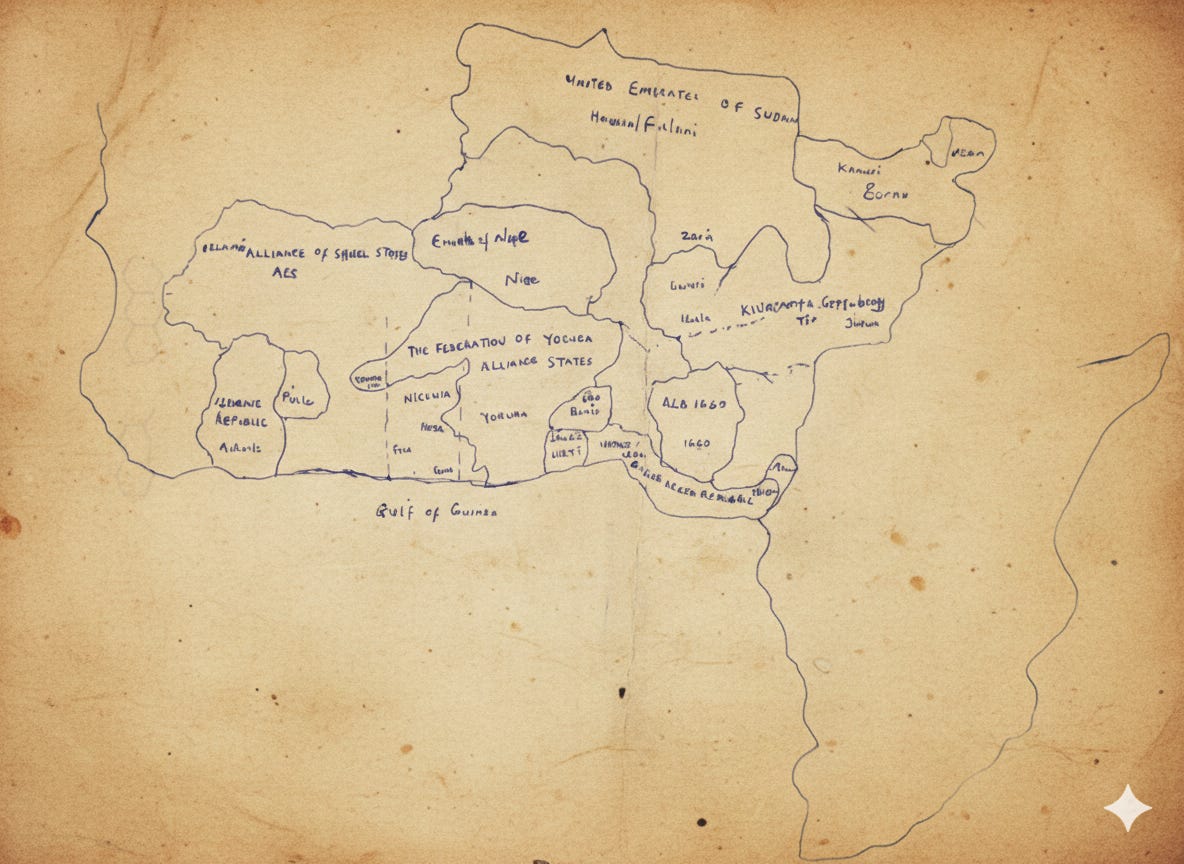
New African States in West Africa

Moving Forward: Why It’s Not Too Late
The African Union should have a conference overseen by all of its partners, including the EU, rather than embracing the policy of upholding colonial borders.
Sub-Saharan African groups ought to be gazetted, and the body should acknowledge their sovereign representatives as human agencies and the voices of their people.
The following outcomes should be adopted by the body:
Reverse all of Berlin’s borders from 1884.
Depending on their circumstances and reality, emerging nations can either adopt or design their own indigenous African political systems and structures or systems of government and structures.
Ratification of statehood with African settings and consent through self-determination.
Encourage ethnic groups with comparable pre-colonial experiences to form states. For example, ethnic groups with histories of belonging to the Songhai, Mali, Ashanti, or Sokoto empires, as well as the Yoruba Nation (Yorùbá kingdoms and city states), Kwararafa Confederacy, and Kanem-Borno Empire, should form union treaties or charters to merge into countries or states.
The requirements should include proximity and economic viability of the emerging states, Contiguous territories and borders, well defined borders, and a stable and permanent population.
Ethno-Political Composition: Minority rights and autonomy must be accorded to dominant ethnic groups in emerging states. Alternatively, states that are heterogeneous—that is, lack dominating ethnic groups—must establish federal constitutions and autonomy.
What the African Borders, Countries and Map may look:


That's correct
This is where Africa has got it wrong for over 65 years and will continue to be the albatross of the Global 🌐 market unless we do some fundamental introspection.
Unity and union are NOT the same thing. In reality, union could be the greatest obstacle to true unity. Today, the Czech and Slovak nations are united in a peaceful and prosperous common market precisely because Slovakia peacefully exited an unwanted union (Czechoslovakia); with no bloodshed and minimal red-tape; not even a referendum was needed.
Unions are a major cause of disunity among African ethnic groups. If for example, most Igbo want Biafra (which they do), there is no reason (except wickedness) to insist on "one Nigeria" for them.
Did you know that the European Union which pan-Africanists (like you) so admire became possible only after Europe’s fractious nations split? The EU (founded in 1993) would have been “Mission: Impossible” if Ireland had not separated from the UK in 1916 or if Tito had lived to “go on with one Yugoslavia” beyond 1992, or if the nine million ethnic Germans who make up Austria were coerced to “go on with one Germany”, or if the half million citizens of landlocked Luxemburg were cajoled into remaining in “greater France”, etc. It is no coincidence that the EU was formed in the wake of the demise of all of Europe’s three unstable federations – Czechoslovak, Yugoslav, and Soviet, which all broke up within 12 months.
"One Nigeria" is a terrible idea and will continue to be a source of crisis or continuous underdevelopment. Why (for example) should Africa tolerate a situation where the Luo are split into five different East African nations? Why should there be not one great Luo nation? If African unity is the motive, border adjustment is an imperative. But Africans are so intolerant and wicked to themselves, all the while thinking they are promoting "unity".