

Reclaiming Safety: Why State Policing is the Critical Next Step for Nigeria
Following the House of Representatives' approval on June 11, 2026, the legislative focus has shifted toward the Senate and state-level ratification.

Preface: This analysis provides an incisive and comprehensive examination of the historical, structural, and operational complexities surrounding the proposed transition toward state-level policing in Nigeria. By tracing the lineage of regional security demands from pre-independence Native Authority systems to the contemporary necessity of decentralized force this document argues that the current centralized model is fundamentally ill-equipped to address the nation’s vast, ungoverned landscapes and the modern threats of non-state actors.
As Nigeria navigates the legislative milestone of the June 2026 State Police Bill, this analysis serves as a strategic roadmap. It moves beyond the discourse of constitutional reform to propose actionable frameworks for infrastructure development, human capital professionalization, and regional cooperation. The goal is to provide a blueprint for a secure, responsive, and technologically integrated policing architecture that can transcend the limitations of the past to ensure the safety and prosperity of the Nigerian state.
The discourse surrounding state-level policing in Nigeria is not new; it is a long-standing aspiration that predates independence. During the colonial era, regional movements particularly in the Western Region advocated for localized control of law and order to address regional security needs. The failure to regionalize the Police Force allowed for centralized interventions that arguably destabilized regional governance in the past.
The Interrupted Peace: From Colonial Consolidation to the Resurgence of Precolonial Conflicts

The Colonial Band-Aid: How British Amalgamation Masked Nigeria’s Unresolved Hostilities
Native Authority Police, the equivalent of Local Authority/Local Government Police, existed in pre-independence Nigeria. During colonial rule, the Action Group Party’s and Western Nigeria’s demands for Regional Police never materialized.
“ CO intelligence reports stressed the A.G campaign on this issue: ‘ continuous pressure is being brought to bear to gain regional control of the forces of law and order’.
Complaints by the AG that most of the NPF personnel in the region were Igbo, not Yorùbá, were followed by moves during 1955 to demand the regionalization of the NPF and to expand the Native Authority (NA) Police, moves that the CO was determined to resist.”
If the aforementioned actions had been taken, it’s possible that Prime Minister Tafawa Balewa’s declaration of a State of Emergency in Western Nigeria and his intervention in internal politics to assert NPC-NCNC influence and suppress the A.G. opposition would not have occurred or been successful.
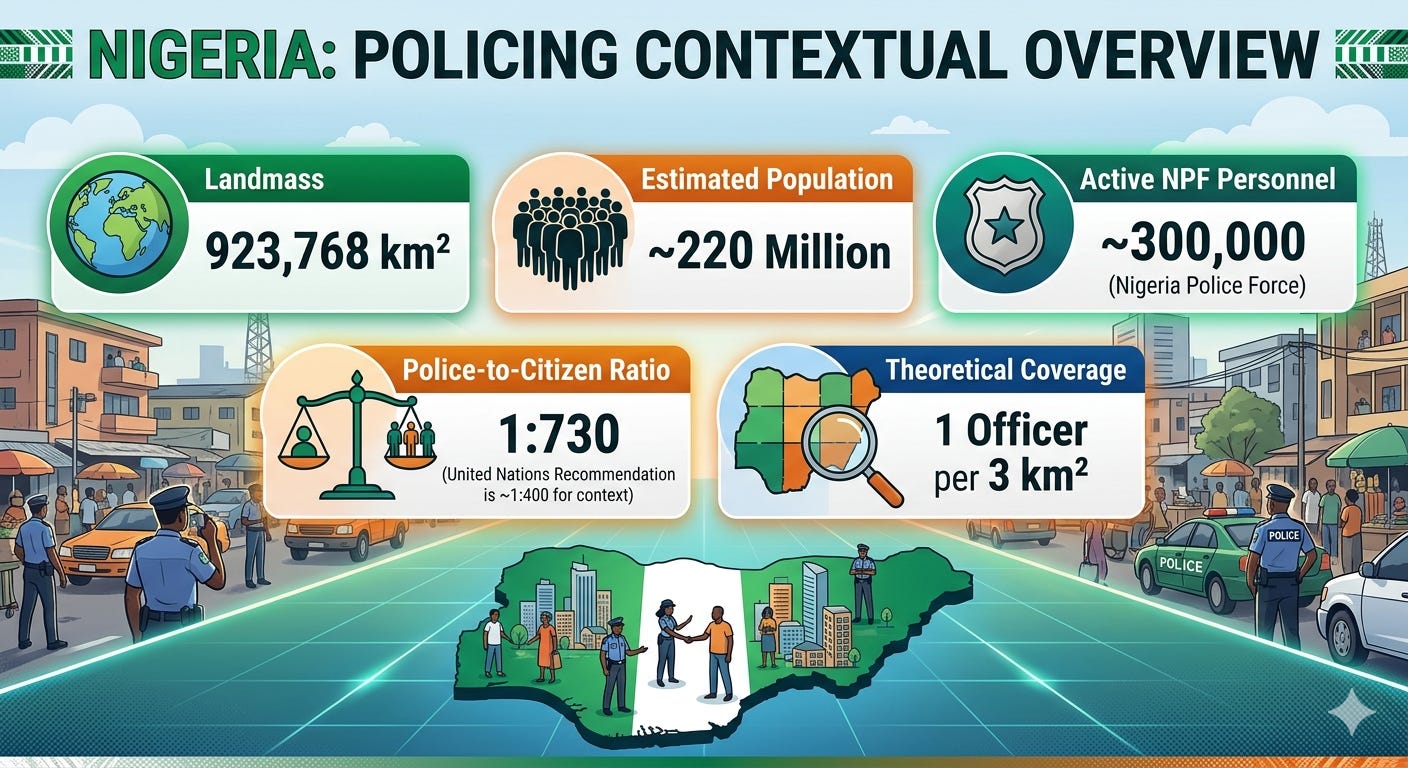
Today, Nigeria’s centralized system is increasingly ill-suited for its vast geography and diverse population. With a landmass of over 923,768 square kilometers and nearly 220 million citizens, the current police-to-citizen ratio of approximately 1:730 leaves vast “ungoverned spaces” vulnerable to non-state actors, including bandit gangs and extremist groups ( IS-Affiliates, Alqaeda, JAS/BH). Since 1999, Nigeria has grappled with persistent insecurity, necessitating a shift toward a decentralized, responsive model.
These areas seldom see NPF or Nigerian military forces, and the communities lack adequate political representation, basic utilities, and access to healthcare and education.
The “Federal Republic of Nigeria” had a centralized policing system that was incredibly ineffective and inefficient for far too long.
In a typical federal structure, policing is a local issue that is impacted by diversity. Theoretically, there would be one NPF officer for every three square kilometres if they were dispersed equally over Nigeria’s geography.
Nigeria’s Police are in charge of maintaining internal security, but they have completely failed in their duties. Although Nigeria doesn’t fight its neighbours, the number of people killed by violent groups each year is comparable to that of wartime, and the brutality and savagery seem medieval.
Nigeria has faced unprecedented levels of insecurity since 1999, when it moved from decades of brutal military dictatorship to civilian and “democratic” rule. These include the rise of JAS/BH and its splinter groups, such as ISWAP and Ansarul, in the North-East and North-Central, Bandits Gangs( the silent Fulani Pastoralist-Hausa farmers civil war in the North-West), ethno-religious and militia violence in the North-Central and its affiliates, oil bunkering, vandalism, and Niger Delta militancy in the South-South.
Since 1999, the South-West Geopolitical Zone has been the most peaceful, with no active theatre. However, this may be about to change. In 2022, the region saw its first-ever Jihadi attack in St. Francis Catholic Church, Owo, Ondo State, which resulted in over 40 fatalities. Fulani Herders began using violence against the region’s farming communities in 2017, which prompted the creation of the Western Nigeria Security Network, codenamed Amotekun, in defiance of the Buhari-led government.
Since 2008, hundreds of thousands of people have died, millions have been displaced, and the Nigerian government has not made the development of state and community policing a top priority. The demand for state police has been heard, but it has remained a cry. This could be changing, though, as the House of Assembly approved the bill to create the State Police on June 11, 2026.
Only one chamber of the parliament has approved the bill. Until a comparable bill is approved by the Senate, harmonised, and approved by two thirds of the state legislatures, it cannot “pave way” for State Police. The legislative process is laborious and bureaucratic, but it is possible; after all, the tax reforms only took a year or so. If the Nigerian State prioritises the protection of its citizens’ lives and property, it might be expedited and optimised.
The Public is still unaware of the entire contents of the enacted State Police bill, but as of the time this article was written, the following sections were known to the public:
Framework and guidelines for the establishment of State Police:
• State Police cannot commence operational policing until:
• Established by a Law of the State House of Assembly, and
• Certified as meeting national minimum standards (prescribed by an Act of the National Assembly)
• State Houses of Assembly may make laws for the establishment, organisation, administration, funding, and oversight of their State Police — but must comply with the Constitution and valid National Assembly Acts.
• States may set higher standards than national minimums but not lower.
• National Assembly laws cannot give federal authorities routine command, deployment, appointment, promotion, transfer, discipline, or control over State Police personnel (except for explicitly authorised federal intervention).
• Exclusive Legislative List adjustments (e.g., light arms for policing purposes; fingerprints/biometrics/forensics shared with State Police; Federal Police listed separately).
The aforementioned shows that states are permitted to establish criteria higher than the federal minimum; this is a feature of federalism’s manifestation of diversity, which should be impacted by social and economic factors.
Professionalizing the Force: A Strategic Imperative
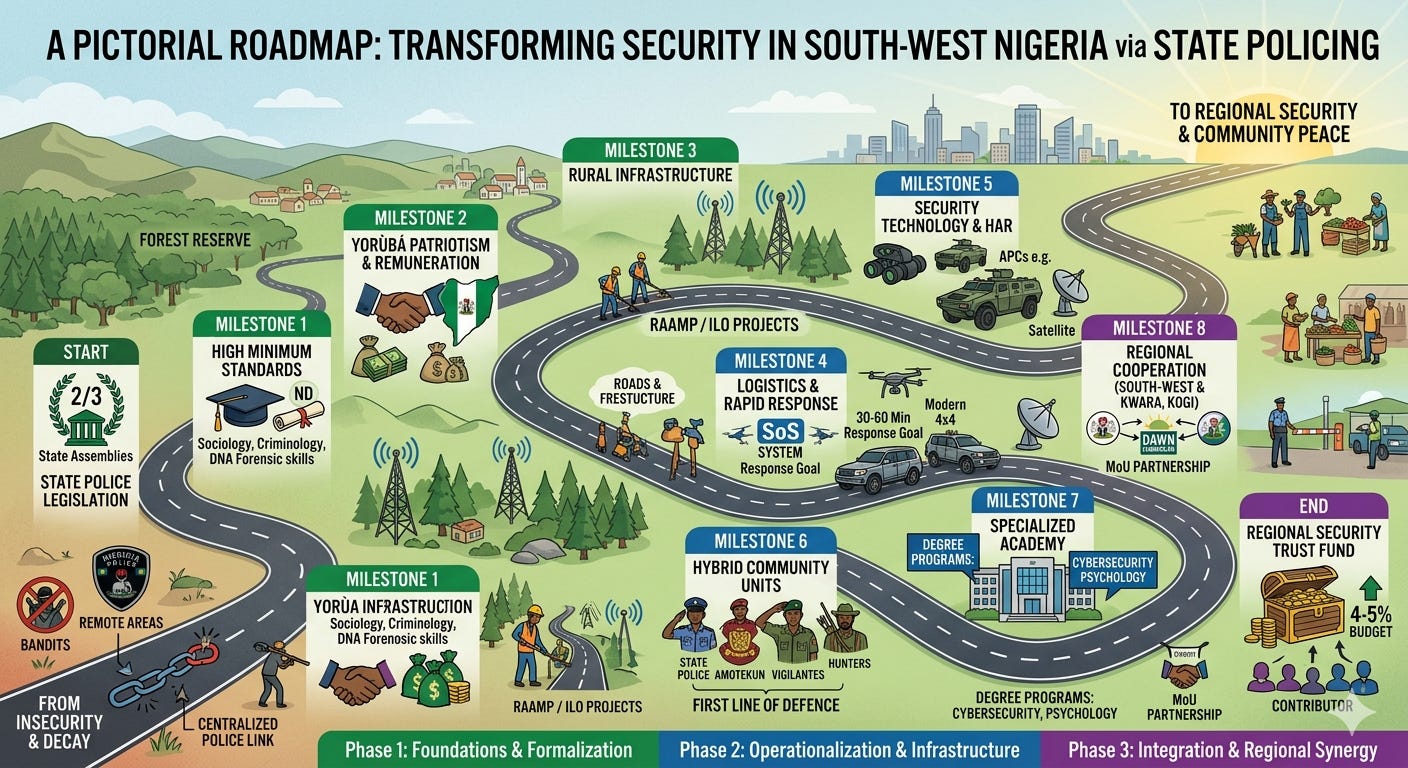
The National Diploma (ND) should be the minimum required academic qualification in Southern Nigerian states, particularly those in the South-West, with an emphasis on IT, sociology, criminology, psychology, economics, biotechnology (including DNA fingerprinting), engineering, and other courses.
To move beyond the stigma that policing is a profession for the “worst” of society, states must transform recruitment and retention. Specifically, in the South-West, a “Professionalism and Patriotism” model is required:
Academic Rigor: In order to “extract the best brains in our society into the Police,” South-West States should propose better enumeration, standards, salary/award structure, and uncompromising professionalism to dispel the populist assumption and stereotype that “policing” belongs to the uneducated and worst members of society. States should set a National Diploma (ND) as the minimum qualification, prioritizing fields such as criminology, psychology, biotechnology, and cybersecurity.
Competitive Compensation: High salaries and award structures must be paired with a narrative of “civic duty,” leveraging regional identity to ensure citizens view policing as a noble, patriotic contribution to their community.
Civic duty: Civic duty must must weaponize the historical legacy of Yorùbá service and valour.
The New State Police will fail and the Federal Police will continue to deteriorate if the most intelligent and well-educated citizens continue to believe the stereotyped “Police.”
Infrastructure and Tactical Modernization
State policing will only succeed if supported by an integrated infrastructure strategy. In states like those in the South-West, Security must be viewed through a socioeconomic lens:
The presence of telecommunications, logistics, and rural access roads, as well as the rural economy, can reduce the need for rural-urban migration patterns that lead to demographic change.
Using Oriire LG as a Case Study: Oriire LG has more than 700 communities without a significant Police Presence. Additionally, there are far too many places without telecommunication service.
The South-West States must prioritise the construction of thousands of kilometres of rural roads connecting forest parks and reserves, farms, and urban centers through World Bank-assisted RAAMP, ILO, and other projects
Possible Privatization of its Forest Reserves for Tourism, Biodiversity and Wildlife
In security, Rapid Response and Deployment are crucial. Examining the trends of Terrorist and Bandit attacks, these were revealed:
Preventing confrontation and resistance by armed groups (Pro Government Militia, Nigerian Armed Forces or Defence groups, Police) is a top priority for bandits and terrorists.
To avoid the aforementioned, they operate for a limited amount of time—sometimes just 30 to 60 minutes.
They prefer to be mobile and adaptable rather than stationary; they raid and kidnap their victims, attack communities without occupying them, and then disappear into the shadows (forests).
They prefer to attack isolated and peripheral towns closest to forests for withdrawal routes because they are still unable to attack urban areas (they also prioritise their own survival and safety).
Therefore, in order to address insecurity in the South-West, comprehensive and multifaceted strategies that go beyond the establishment of state police are needed. These include:

Enhancement of Communication Services in Remote and Rural Areas, Particularly in Border Regions
Building rural roads with a strong emphasis on access, quick response, deployment, and flexibility
Building Weaponry, Security Posts, Camps, and Stations in Remote Towns and Communities
The provision of basic amenities (such as schools, water, electricity, and healthcare facilities) and agricultural assistance/support projects (such as cooperative societies, loans, cold and dry storage facilities, markets, and logistics).
Drone and surveillance technology for aerial surveillance to prevent ambushes and collect intelligence and mapping, as well as a SoS technology system that instantly signals distress calls for quick deployment and response times.
Hardware procurement: State governments, ProForce Company, and others could enter into a Memorandum of Understanding for the supply of night vision goggles, armoured personnel carriers (APCs), anti-ballistic and bulletproof vests, helmets, and other items.
The Creation of a community policing architecture with vigilante groups, hunters, and pro-government militia groups (OPC, Agbekoya, etc.) as the first line of defence and security.
The Creation of a Specialised Police Academy or University in the Southwest with degree-granting programs related to security, such as biotechnology, psychology, sociology, cyber security, and others, and access to government-funded grants and scholarships.
The Creation of Central Control/Operation Systems and Facilities for coordinated security and synchronisation of all agencies’ operations, particularly in hybrid units (Amotekun, State Police, Military, Vigilante, etc.)
Creation of training facilities for topics such as ballistic testing, security technologies, handling weapons, ethics, human rights, conventional laws, intelligence gathering, contemporary technologies, and combat, among others. A Memorandum of Understanding on Partnership and Cooperation should be signed by all South-West States, Kwara, Kogi, and their State Police.
Formalisation and creation of a Regional Security Trust Fund by South-West States under the DAWN Commission, financed by donations, grants, NGOs, private investors and stakeholders, and 4-5% of each state’s annual budget.
Conclusion: By adopting this multi-faceted approach combining legislative reform, elite human capital development, infrastructure investment, and regional cooperation Nigeria can finally pivot toward a more secure, localized, and effective policing paradigm.