

Aviation Sector In South-West: Cart Before The Horse Scenario
Prosperity Dilemma: Economic Activity, Railway, Road transportation or Airports?

This article continues the discussion of Yorùbáland’s economic corridors, which I divided into two general categories based on geography, historiography, Yorùbá dialects, access to the sea, west or east of Ifè Centre Point, and direct economic relationships. These are the Western Yorùbáland Corridor (west of Ile-Ife) and the Eastern Yorùbáland Corridor (east of Ile-Ife).
Nigeria's Yorùbáland Geo-Economy - Prospects and Plans

In general, Yorùbáland, which is part of Nigeria, is divided into two geo-economic zones or corridors: The Western and The Eastern.
A. Economic Activity: Should airports be prioritised over high economic activity, traffic, and demands? Is it a chicken or an egg question?
B. A Comparative Analysis of Global North and Global South Income Parity:
Using the United States, United Arab Emirates, and sub-Saharan Africa (especially Nigeria) as case studies, examine how average national income affects flight economy, traffic, demands, and viability. Could the masses in a continent, nation, or subregion with low average incomes desire or be able to afford flight travel?
C. Priority Scale: Road, Water, Air/Flight, and Railway
Which of them ranks highest on the priorities scale appropriate to our circumstances? Roads, waterways, interconnected railroads, and airports?
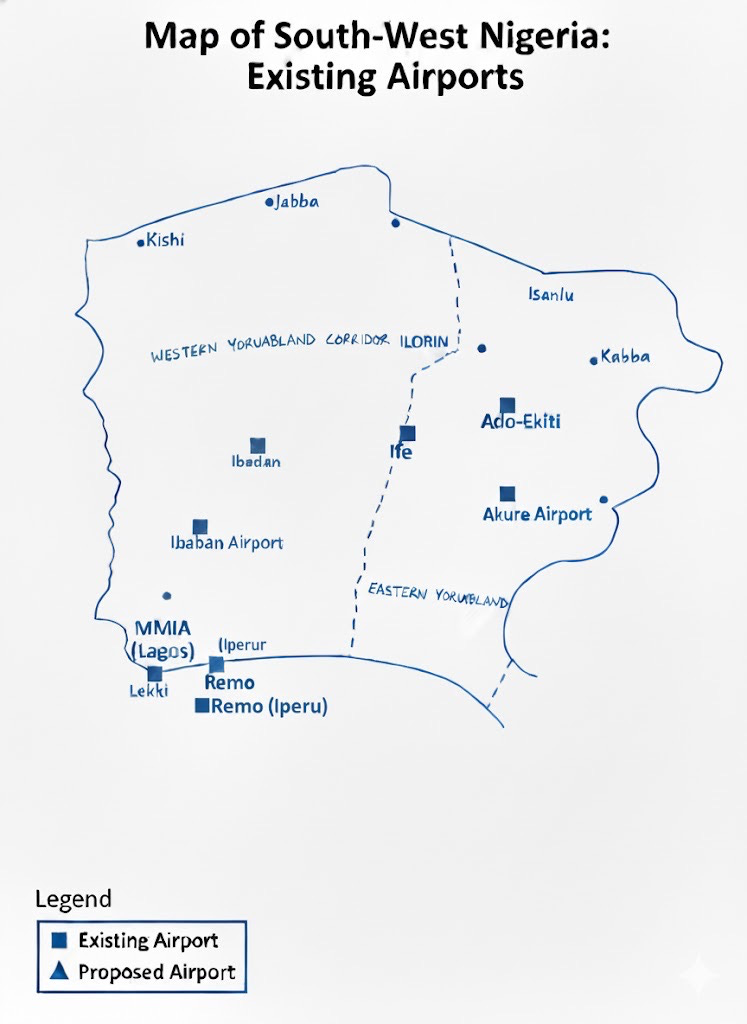
For economic reasons, airports in Yorùbáland’s Western Corridor—Lagos-Ogun-Òyó—make more sense than those in the Eastern Corridor.
What should be the priorities of the Eastern Yorùbáland corridor and why airport is a misplaced priority.
A. The economic activity resulting from services, trade volume, industrialization/manufacturing, and commercial business activity decides whether an airport or sea port is viable.
B. It is clear that the Global South’s standard of living, HDI, per capita income, and many other human indices are significantly lower than those of the Global North.
The parity is symbolic of the sky and the ground
Since air travel is more expensive than land transportation on average, most people in the Global South would rather travel by road and train than by air for financial reasons.
Indeed, if a survey were to be conducted in the Global South and North asking people if they had ever taken a flight in their lifetime, I’m confident that the vast majority of people in the Global South would say they had never taken a flight.
This would be a stark contrast to the percentage of people in the Global North who would say the same.
Therefore, why should State Governments use limited resources to undertake such a misguided priority project while ignoring projects that would better suit the economic circumstances of the society in which they live, projects that would have a greater impact and promote sustainable growth and development, and projects that, with the exception of a few Nigerian states, do not require international airports.
Since Africa’s landmass is much larger than that of Europe, the United States, and many parts of Asia, the distance travelled is greater. However, the majority of Africans prefer land transportation for economic reasons rather than the lack of airports or aeroplanes; therefore, the solution is not to build more airports that they will not use, but rather to raise the HDI, national per capita income, standard of living, etc.
C. Road, railroad, and air are in order of priority.
These two situations are present in the South-West Geopolitical Zone: low economic activity with no vitality to support it is worse than high economic activity with subpar or nonexistent airports.
The latter is present in Yorubáland’s Western Economic Corridor (Lagos-Ogun-Òyó), while the former is present in the Eastern Economic Corridor.
Nigeria has six international airports, but MMIA in Lagos accounts for more than 80% of all air travel in the country. This is due to both economic activity in Lagos and its surrounding area and a lack of activity in the corridors where the other five international airports are situated.
Lagos, however, has begun construction of a new international airport in Lekki, while FG has begun the complete rehabilitation and reconstruction of MMIA. Since Ogun State has become a major industrial and manufacturing hub in Nigeria, home to several manufacturing facilities and businesses, the ongoing construction of an airport in Ogun State—which is nearly complete—and its proposed deep sea port are not out of priority.
The Lagos infrastructure has been neglected for decades and has become a significant burden for the state. With Ogun State’s proposed deep sea port development and ongoing airport, the entire Western Economic Corridor of Yorùbáland will prosper even more. Lagos has been the only one to rely on without offering complimentary funding to upgrade its facilities like Tin Can and Apapa Sea Port as well as MMIA.
With permission from FG, the State Government of Òyó State has started the process of upgrading the current local airport into an international airport.
An international airport in Ibadan might serve the nearby states of Kwara and Ọṣun and bring in some respectable traffic. In stark contrast, States In contrast to the Western Economic Corridor of Yorùbáland of Lagos-Ogun-Òyó-Kwara, the Eastern Economic Corridor of Yorùbáland-Ọṣun (Centre), Èkìtì, Ondo, and extending to Okunland in Kogi has low economic activity. As a result, industrialization, manufacturing, and services should take precedence over the need for airports. Regrettably, the State Government has started construction of its Agro-Cargo Airport, which is expected to be underutilised due to low economic activity.
Rather of investing limited funds in building new local airports or converting current ones into international ones, Yorùbáland’s Eastern Economic Corridor should prioritise:
Enhancing SME/MSME
Investing in Religio-Cultural Tourism and Hospitality to UNESCO standards: Using historical, religious, and cultural sites for the Diaspora Community, such as Ifá Temple and Holy City in Ile-Ife, Sango Timi Shrine, Erin-jesa water fall, etc
Using the hospitality sector that supports them through PPP template
Ikogosi Water Spring in Ikogosi Èkìtì State is a case study.
Agro-Industrialization: Large-scale investments in agriculture and its value chain, such as farm settlements and clusters, agro-industrial parks and logistics, financing and subsidising farm inputs, farm loans to Co-operative societies, educating farmers about modern agriculture and 21st-century techniques through seminars and extension services, offering the best farm inputs—such as high-yielding seeds and fertilizer—and aggregating offtake/buy directly from farmers for storage, among other things, Rural road and connectivity investments through RAAMP, as well as basic rural facilities like PHCs, elementary and secondary schools, water projects, national grid electrification, or the sachetization of green energy through solar farms, storage facilities, cold and dry, etc.
Investment in the Technical, Skill, and Service Sectors:
Technical colleges should be updated, provided with funding, and reorganised to meet the demands of the 21st century. Special emphasis is needed in skill areas such fashion design, such as Osogbo and Èkìtì Adire, Aso Ofi, leather, tailoring, etc.
Young graduates’ interest and ventures in the fashion industry, particularly in design and tailoring, are clearly on the rise, but many of them lack the funds to buy the heavy industrial equipment they would require once they graduate.
The government can close this gap by building some Fashion Workshop Hubs in its financial capitals where these diligent apprentices could receive Pay-to-Rent Per Work-rate/Hour depending on the machine. This Pay as You Use Model would not only provide jobs for these teeming skilled youths but also empower them to have better revenues, make it easier for them to thrive, and be a state-owned business enterprise that generates revenue.
People frequently recall the early days of GSM and Internet service, when buying a network SIM card was highly costly and many people who wanted Internet access would go to cyber cafes or call centres.
Digital Economy:
Engineering, AI, Robotics, Virtual/Augmented Reality, Blockchain, machine learning, and other aspects of the digital economy/services are also popular among the Youths. If intentional policies are aimed at this ecosystem, Yorùbáland has the potential to become one of the world’s leading centres and the Silicon Valley of sub-Saharan Africa.
Concerned about my future after graduating from Obafemi Awolowo University a few years ago, a few members of FHG or Neo Life approached me and offered to teach me some of these skills as a way to empower young people in Nigeria, where there is a severe shortage of jobs.
There are thousands of stories about how this group and its members have taken advantage of the anxieties, fears, zeal, ambition, and passions of many young people who are eager to learn digital skills.
However, the government has not paid close attention to this and has not offered an alternative ecosystem to take in these bright young people, so they remain victims of these exploitative organisations.
Establishing Technology Incubation Hubs in each LGA in Yorùbáland would help to address this issue. By providing conducive learning environments, these hubs will help to unlock the creative and digital economy in Yorùbáland.
Logistics and Transportation Services:
Regionally coordinated railway investments in Yorùbáland will release enormous economic benefits instead of “Agro-Cargo Airport” or just airports. Emerging industries require distribution networks for both raw and finished goods, therefore building a state-of-the-art goods and passenger railway across Yorùbáland will have repercussions.
Lower the cost of raw and completed product transportation to lower inflation, generate employment within its ecosystem. Transportation systems that are easier to use, roads that are more durable and long-lasting, fewer travel fatalities, and improved safety all encourage industrialization because of the large number of raw and finished goods that can be delivered more quickly and at a lower cost.
The railway will stimulate trade and commerce, facilitate the flow of commodities, goods, and services, as well as skills, and establish population clusters across trade and economic centres. It will also improve the inter-city connectivity of commercial hubs, cities, and towns. Additionally, it will improve the HDI, lower poverty, and raise regional per capita income.
The proposed Ondo Multipurpose Deep Sea Port Development has failed to draw private investments because of concerns about investors’ faith in its economic viability, despite the fact that the Eastern Yorùbáland Economic Corridor merits at least a Deep Sea Port in Coastal Ondo State (Ilaje). Economic activity that would support the sea port’s import-export activity, industries’ and manufacturing enterprises’ demand for raw materials, and the export of their final products—the main lifeline of the marine economy—is still lacking in the Eastern Yorùbáland Economic Corridor.
The sea port will be dormant and receive little use or patronage from shippers and cargo in the absence of strong economic activity. Apart from Lagos Ports, other ports in coastal Nigeria are also subject to this.
Lagos Ports depends on the Western Yorùbáland Economic Corridor (Lagos-Ogun-Òyó-Kwara), which is economically viable because of the GDP-PPP and the presence of manufacturing and industrial firms in the corridor.
The Yorùbá Coastal stretch of Ondo State (Ilaje) was always neglected or underutilised.
Until the 1470s, when Portuguese traders made contact with Eko (Lagos), Commercial activity then began on the Lagos island, drawing many Yorùbá itinerant traders from Ijebu, Owo, Ilaje, and even Edo/Benin later in the 16th century. Lagos and Badagry gained even more prominence in the global transatlantic commerce network by the time of the Transatlantic Slave commerce. When slavery was outlawed and palm oil and other legal trades began to take place, Lagos ports became even more important.
In comparison to Lagos Island and its environs, the coast of Ondo, or Eastern Yorùbáland, has a lower population now due in large part to under-utilisation and neglect. The proposed Abidjan-Lagos Highway and the ongoing Lagos-Calabar Coastal Highway, however, might be the catalyst for the impending transformation.
Lagos - Fulcrum (Orita-Meta) of Coastal West Africa Economic Corridor

The Lagos Corridor, also known as "Greater LAGOS" for the purposes of this article, is located at the Orita-Meta (intersection) of the Lagos-Ogun-Oyo/Ondo Economic Corridor. This article focuses on three significant road infrastructure projects discussed below: